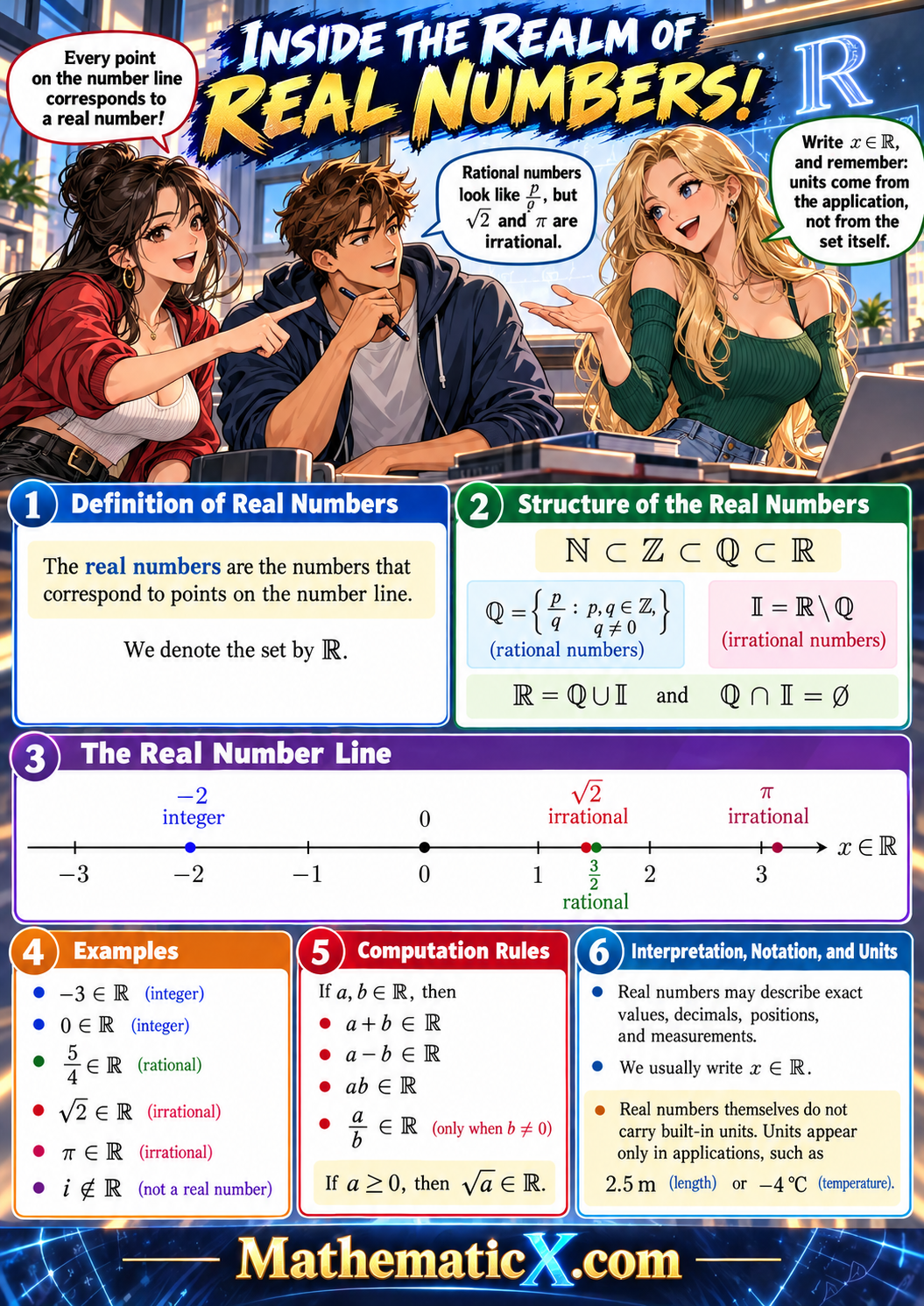
How can a single number system describe positions on a line, exact algebraic quantities, and measurements? The real number system, denoted by \(\mathbb{R}\), provides a common setting for these ideas. Every point on the real number line corresponds to exactly one real number, and every real number corresponds to exactly one point.
The familiar sets of natural numbers, integers, and rational numbers fit within the real numbers. Rational numbers can be expressed as a quotient of integers with a nonzero denominator, while irrational numbers are real numbers that cannot be expressed in this way:
\[\mathbb{Q}=\left\{\frac{p}{q}:p,q\in\mathbb{Z},\ q\ne 0\right\},\qquad \mathbb{I}=\mathbb{R}\setminus\mathbb{Q}.\]Consequently, \(\mathbb{R}=\mathbb{Q}\cup\mathbb{I}\) and \(\mathbb{Q}\cap\mathbb{I}=\varnothing\). For example, \(-3\), \(0\), and \(\frac{5}{4}\) are rational real numbers; \(\sqrt{2}\) and \(\pi\) are irrational real numbers. The imaginary unit \(i\), which satisfies \(i^2=-1\), is not real.
The illustration locates selected values on the real number line. Although \(\sqrt{2}\) and \(\frac{3}{2}\) lie close together, their exact positions differ: \(\sqrt{2}<\frac{3}{2}\). The fraction is rational, whereas the square root is irrational; both are real.
Real arithmetic is closed under addition, subtraction, and multiplication. Division produces a real number when the divisor is nonzero. The real square root \(\sqrt{a}\) is defined for \(a\ge 0\), and its value is nonnegative. Thus, the permissible domain matters: \(\frac{a}{0}\) is undefined, and \(\sqrt{-1}\) is not a real number.
The notation \(x\in\mathbb{R}\) states that \(x\) is a real number. The set \(\mathbb{R}\) itself has no physical units: units such as meters or degrees Celsius belong to the measured quantity or application. This distinction lets the same numerical framework support both exact mathematical reasoning and quantities encountered in everyday life.
Example 😀 \(\sqrt[3]{x}\)
\[\int_{a}^{b}f\left(x\right)dx\]