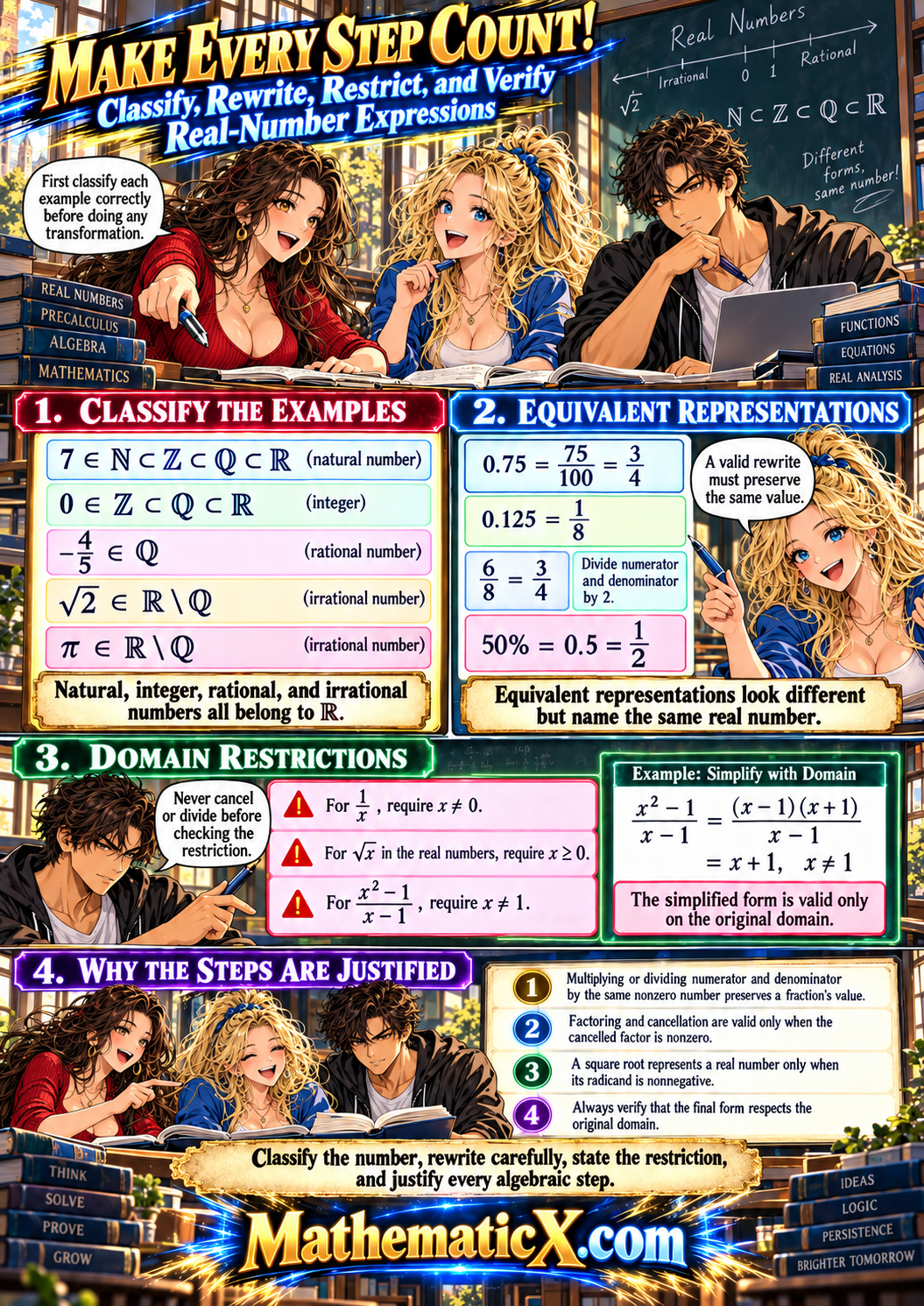
How can you tell whether a number belongs to a particular set, rewrite it without changing its value, and avoid a simplification that silently changes its domain? This illustrated precalculus lesson follows three university students as they classify examples in the real number system, compare equivalent representations, check restrictions, and explain each valid algebraic step.
Classify real numbers before calculating
The natural numbers, integers, and rational numbers sit inside the real numbers. For example, \(7\in\mathbb{N}\subset\mathbb{Z}\subset\mathbb{Q}\subset\mathbb{R}\), while \(0\in\mathbb{Z}\subset\mathbb{Q}\subset\mathbb{R}\). The number \(-\tfrac45\) is rational because it is a ratio of integers with a nonzero denominator. Both \(\sqrt{2}\) and \(\pi\) are irrational real numbers: they belong to \(\mathbb{R}\setminus\mathbb{Q}\). The smallest named set containing an example offers a useful classification, but a number can also belong to every larger set in the inclusion chain.
Rewrite a value in equivalent forms
A decimal, fraction, or percentage can represent exactly the same real number. The image illustrates these identities:
\[0.75=\frac{75}{100}=\frac34,\qquad 0.125=\frac18,\qquad \frac68=\frac34,\qquad 50\%=0.5=\frac12.\]To reduce \(\tfrac68\) to \(\tfrac34\), divide both numerator and denominator by \(2\), a nonzero common factor. In general, multiplying or dividing numerator and denominator by the same nonzero number preserves a fraction’s value, provided the original denominator is nonzero. Changing a representation is not the same as changing the number itself.
State the original domain before simplifying
In the real numbers, the expression \(1/x\) requires \(x\ne0\), and \(\sqrt{x}\) requires \(x\ge0\). For a rational expression, exclude every value that makes its original denominator zero, even if that denominator later cancels.
Consider the illustrated example. Factor the numerator, then cancel only when the factor being canceled is nonzero:
\[\frac{x^2-1}{x-1}=\frac{(x-1)(x+1)}{x-1}=x+1,\qquad x\in\mathbb{R},\ x\ne1.\]The simplified expression \(x+1\) is defined at \(x=1\), but the original fraction is not. Therefore, the two expressions are equivalent only on the original domain, \(\mathbb{R}\setminus\{1\}\). Cancelling \(x-1\) without retaining \(x\ne1\) would incorrectly add a value to the domain.
Why these steps are valid
Each transformation has a mathematical reason: set membership follows the definitions of number classes; fraction reduction divides by a nonzero common factor; factoring uses the difference-of-squares identity \(x^2-1=(x-1)(x+1)\); cancellation requires \(x-1\ne0\); and a real square root requires a nonnegative radicand. The final check is to compare the result with the original domain restrictions, not merely with the simplified expression.
The guiding method is simple: classify the number, preserve the value, state every restriction, and justify each algebraic step.
Leave a comment, ask a question, or reply