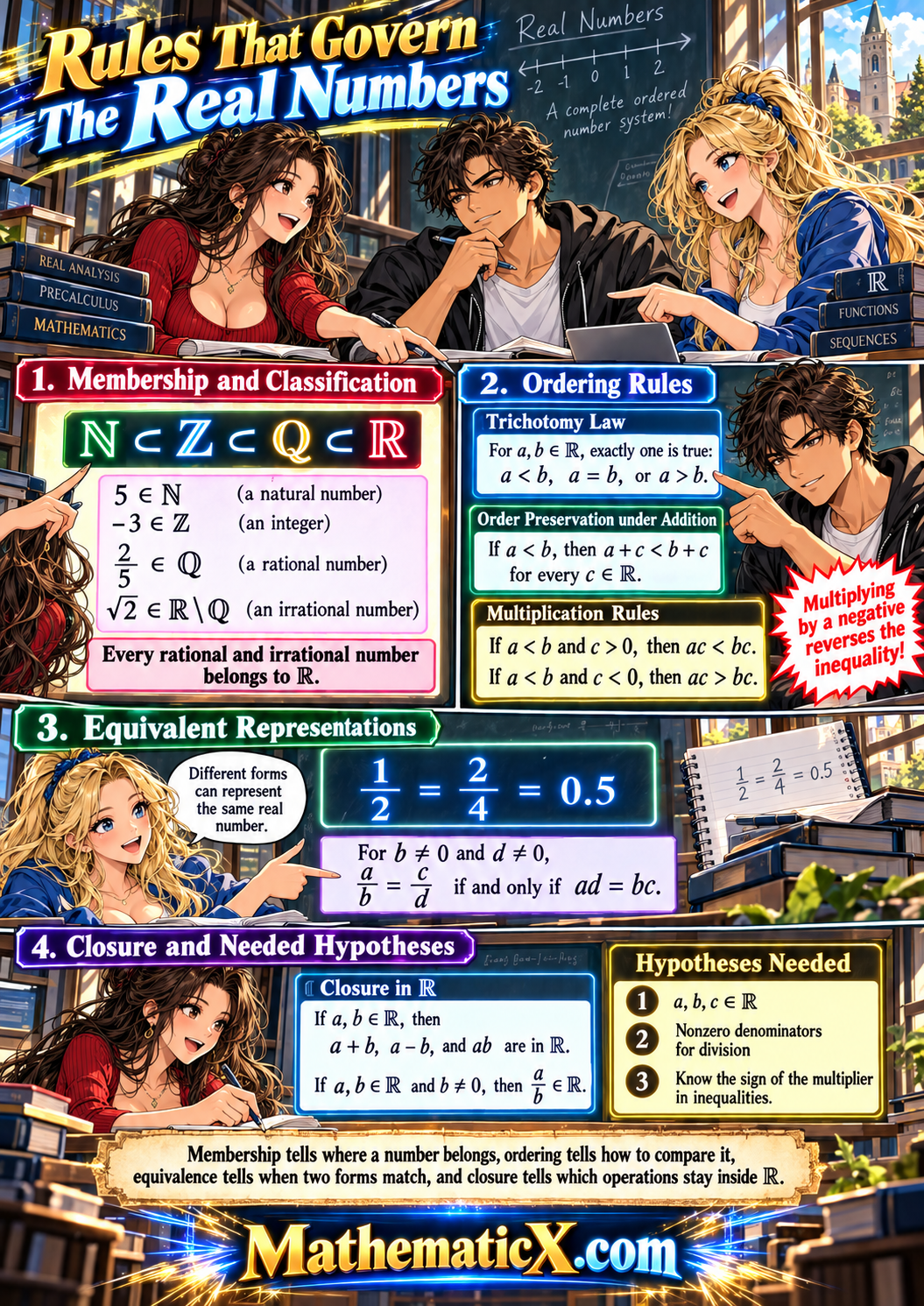
The real number system provides a common setting for classifying numbers, comparing their sizes, recognizing equivalent representations, and performing valid arithmetic operations. In the illustrated lesson, three university students connect these four ideas and identify the conditions that keep each rule valid.
Membership: where does a number belong?
The natural numbers, integers, and rational numbers form nested subsets of the real numbers:
\[\mathbb{N}\subset\mathbb{Z}\subset\mathbb{Q}\subset\mathbb{R}.\]For instance, \(5\in\mathbb{N}\), \(-3\in\mathbb{Z}\), and \(\tfrac25\in\mathbb{Q}\). An irrational number is real but not rational, as illustrated by \(\sqrt2\in\mathbb{R}\setminus\mathbb{Q}\). A single number may belong to several of these nested sets; classifying it as an integer does not prevent it from also being rational and real.
Ordering: when does an inequality stay true?
The trichotomy law says that, for real numbers \(a\) and \(b\), exactly one of \(a<b\), \(a=b\), or \(a>b\) holds. Adding the same real number to both sides preserves a strict inequality:
\[a<b\quad\Longrightarrow\quad a+c<b+c\qquad(c\in\mathbb{R}).\]Multiplication requires an additional hypothesis: the sign of the multiplier matters. For \(c>0\), multiplication preserves the direction, giving \(ac<bc\). For \(c<0\), it reverses the direction, giving \(ac>bc\). If \(c=0\), both products are equal, so neither resulting strict inequality holds.
Equivalence: different forms, one real number
The illustration compares three representations of the same value:
\[\frac12=\frac24=0.5.\]For real numerators and nonzero denominators \(b\) and \(d\), the equality of two fractions can be checked by cross multiplication:
\[\frac ab=\frac cd\quad\Longleftrightarrow\quad ad=bc,\qquad b\ne0,\ d\ne0.\]This equivalence is valid because each denominator is nonzero; without that condition, at least one of the fractions would be undefined.
Closure: which operations stay inside the real numbers?
The real numbers are closed under addition, subtraction, and multiplication. If \(a,b\in\mathbb{R}\), then \(a+b\), \(a-b\), and \(ab\) are also real. Division remains real when the divisor is nonzero:
\[a,b\in\mathbb{R},\quad b\ne0\quad\Longrightarrow\quad\frac ab\in\mathbb{R}.\]When applying these rules, first confirm that the variables are real, that all denominators are nonzero, and—when multiplying an inequality—that the multiplier’s sign is known. These hypotheses distinguish a valid transformation from an undefined operation or an incorrect comparison.
Leave a comment, ask a question, or reply